PROXECTO MULTIDISCIPLINAR 19-20: A TECNOLOXÍA NAS NOSAS VIDAS
CLUB LECTURA 4º ESO. 8ª SESIÓN: Á LUZ DAS CANDEAS
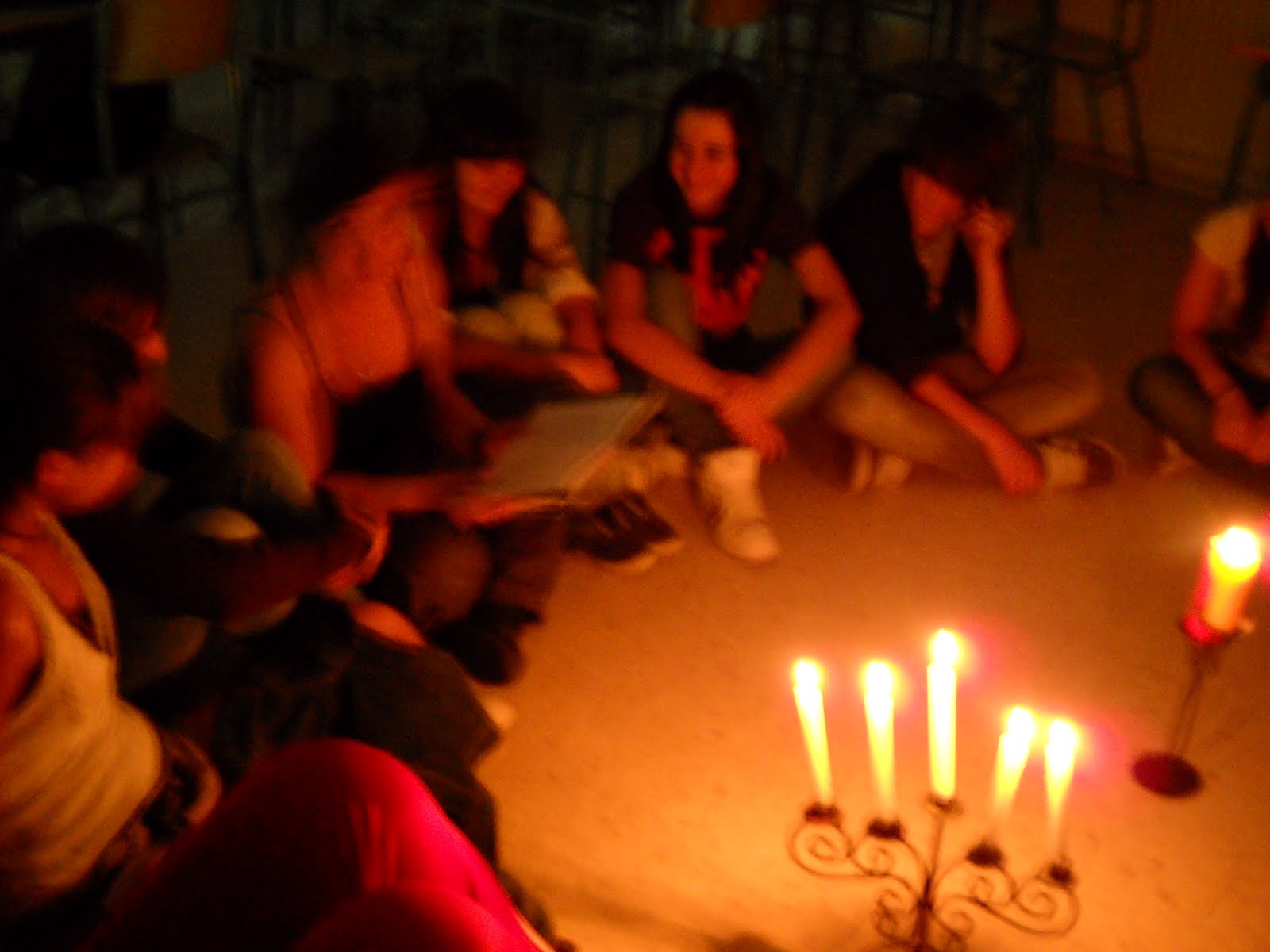
Desta vez, é a profesora a que, a falta dun contacontos profesional, le “Aleluia”, á luz das candeas, do libro de relatos Á lus do candil.
O que ignoran os clubeir@s é que contamos cun especialista en efectos especiais de moito talento. Santi Piovene, que xa tiña lido estes relatos, axudou a acelerar o ritmo cardíaco dos seus compañeiros, mesmo houbo berros, coa imitación do “ta, ta, ta…” do caiado no chan batendo estrondosamente unha porta ou cando o “Pan!...” dunha porta que se abre converteuse no pesado volume 1 do dicionario Gran Xerais caendo no chan. Descubrimos, ademais doutra funcionalidade dos dicionarios, que, ademais dun bo conto, os efectos especiais son esenciais para conseguir empatizar coa historia.
CLUB LECTURA 4º ESO. 7ª SESIÓN: RELACIÓNS AFECTIVAS E EMOCIONAIS
O martes 31 de maio no Club de Lectura de 4º ESO unha lectura de contos taoístas, zen referidos ás emocións.
1ª lectura : Os lobos. Lido por Adrián Vilaboa e Santi Piovene.
2ª lectura: O valor das cousas. Lido por Marta Cabaleiro e Nerea Fernández.
3ª lectura: O samurai e o pescador. Lido por Carla Lago e Aida Darriba.
4ª lectura: Conto taoísta. Estefanía Calvar e Estela Cabaleiro.
CLUB LECTURA 4º ESO. 6ª SESIÓN: ENCONTRO/OBRADOIRO CO ILUSTRADOR ABRAHAM CARREIRO
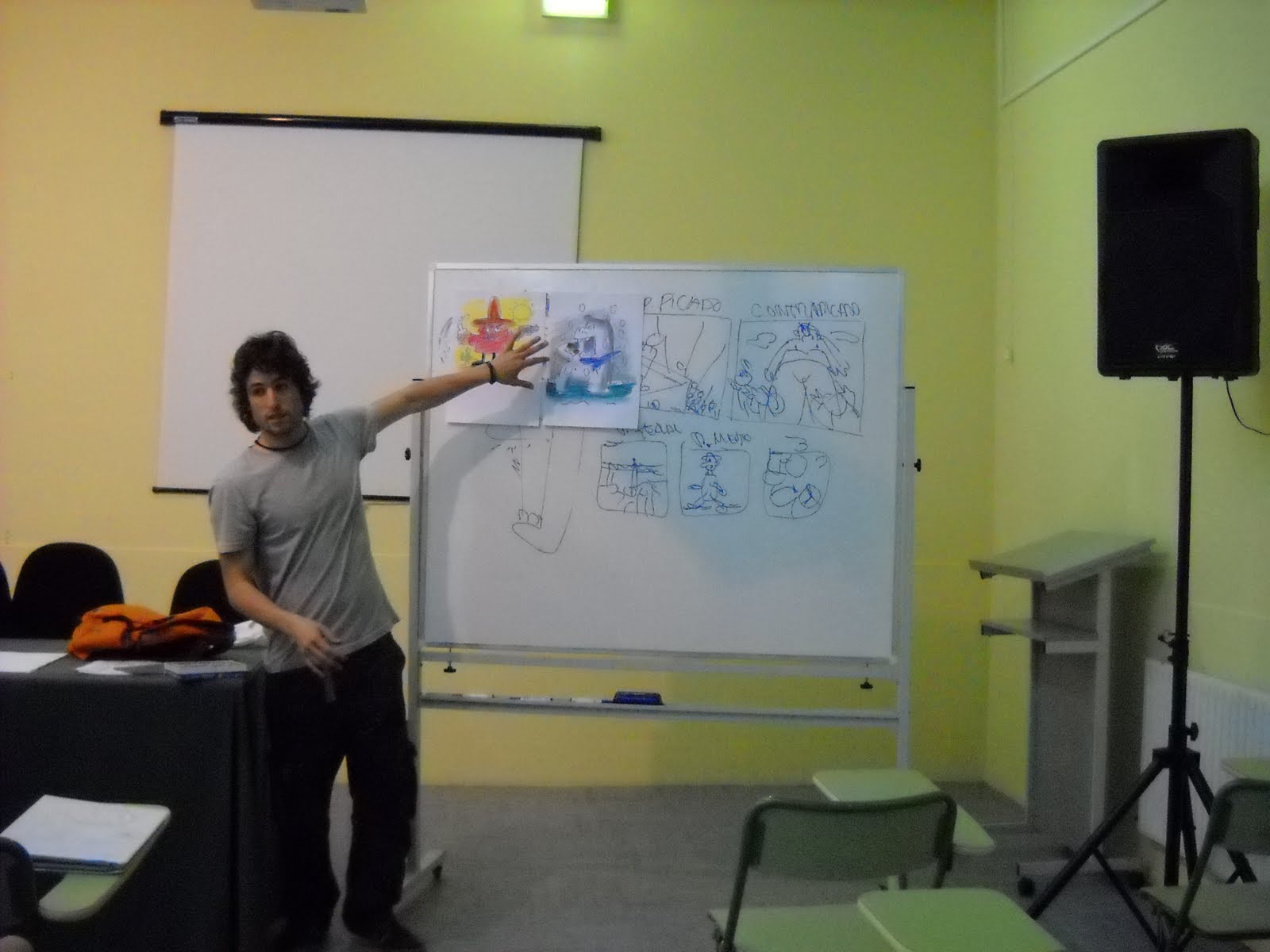
E aprendimos a reflectir as emocións a golpe de lapis (ledicia, tristura, enfado…), dar movemento ao estático papel, ou mesmo a crear os nosos personaxes.
Aí van algunhas notas que tomou a alumna Shelby Kuuipo Crespo Bush (4º A de ESO) para que vos fagades unha idea do que aprendemos no obradoiro.Para debuxar un personaxe, hai que coller a cabeza como referencia para que teña en todo momento as mesmas medidas.
Para que sexa máis animado, dámoslle forma para que pareza ter máis velocidade e non ser tan cadrado o boneco. No caso contrario, se fose realista, non o fariamos.
Esaxerando diversas caras, expresións.
Esaxerar sen medo, con moita expresión. Pódese combinar diferentes caras e obtemos outras.
Para saber máis sobre o autor visita a biblio-biografía de Abraham Carreiro...
CLUB LECTURA 4º ESO. 5ª SESIÓN: SHAKESPEARE IN LOVE
ABOUT THE FILM.........SHAKESPEARE IN LOVE
Set in the late 16th century London, the film directed by John Madden portrays a more humanised image of the historical figure of William Shakespeare. The script brings out the human element, all the emotions and problems that go with it.
We can see the beginnings of Shakespeare as a play writer. The first recorded mention is by another playwright, Robert Green, who called him “ an upstart crow” in 1592.
One of the most fascinating things about Shakespeare is that most of his life is a complete mistery. That makes it possible to speculate on a romance as we see on the screen.
The original idea of the film came from writer and producer Marc Normann, who wondered what led Shakespeare to write ROMEO AND JULIET, the play with which he really “ finds his voice” mixing genres: beginning with a love story and comedy which shifts into a tragedy presenting radical new ideas for his time.
It has been awarded with seven oscars including best actress, best script and best film.
The screenplay, written by Marc Normann and Tom Stoppard is one of the film’s main attractions. Both have achieved a very witty and at the same time respectful language full of suggestive word plays, innuendos(1), and double meanings ( three of Shakespeare talents which delighted British audiences at that time).
Most of the characters in the film SHAKESPEARE IN LOVE are real : Chistopher Marlowe a major playwriter of the 16th century author of Dr. Faustus and Edward the Second, Richard Burbage was the son of James, who built London first theater, The Curtain. Philip Henslowe another of the pioneering impresarios who built his theater The Rose on Bankside in 1584 and his censor Master of the Revels, Sir Edmund Tilney.
(1) indirect remark about somebody’s body usually suggesting something rude or mean.
CLUB LECTURA 4º ESO. 4ª SESIÓN: HAMLET (Texto)
HAMLET´S PLAYSCRIPT
Main characters:
CLAUDIUS ………………………………............ King of Danemark
GERTRUDE…………………….........…………... Queen of Danemark
HAMLET………………………………..........…… Prince of Danemark
HORATIO …………………………...........…….. Hamlet’s best friend
ROSENCRATZ............................................ Hamlet’s friend
OPHELIA …………………………………........... Hamlet’s beloved
POLONIUS....................................................... Ophelia’s father
LAERTES ……………………………...............……… Ophelia’s brother
GHOST ………………………………...............…….. Hamlet’s father
PEOPLE
NARRATOR
1st SCENE
NARRATOR: People of Danemark: ‘ Claudius always wanted to be a king. Hamlet is the true king after his father’s death. But Claudius didn’t want that. That’s why he married Queen Gertrude.’
HAMLET: ‘ How can my mother forget my dear father so quickly?’ He loved her so much. But on two months after his death, she’s married my uncle.
CLAUDIUS: ‘ Hamlet you are like a son to me. Why are you still unhappy about your dead father? I’m your father now.’
GERTRUDE: ‘ don’t think about your father so much. Everybody has to die. Why do you look so sad?
HAMLET: ‘ I can’t forget my father quickly.’
2ND SCENE
HORATIO: ‘ I saw a ghost on the walls of the castle last night’
HAMLET: ‘What ghost? What did it look like?
HORATIO: ‘It looked like your dead father.
HAMLET: I’ll watch with you tonight. Perhaps it will come again. I’ll talk to it.
NARRATOR: That night, Hamlet joined Horatio. It was nearly midnight. Suddenly Horatio looked up and cried out.
HORATIO: There’s the ghost!
HAMLET: Tell me who you are. What do you want?
GHOST: I’m your father’s ghost. I was murdered by Claudius, your uncle. When I was asleep in my garden he poured poison into my ears. Nobody knew how I died.
You must do something, Hamlet. You must kill Claudius for his crime. But don’t hurt your mother. But remember me.
HORATIO: Are you all right? What did the ghost say?
HAMLET: Don’t tell anyone about tonight ! Don’t tell anyone about the ghost!
3 RD SCENE
NARRATOR: After he met the ghost, Hamlet changed. He pretended to be mad. He said and do very strange things. Her mother became more and more worried about her son.
HAMLET: I’m not happy now. I can’t enjoy anything and I never laugh. Nothing in the world is interesting or beautiful, everything is ugly.
ROSENCRATZ: Some actors are coming to act in a play. You always enjoy plays.
NARRATOR: The play was about the death of an old king. Then Hamlet had got an idea.
HAMLET: I’ll ask the actors to act a story which is like the death of my father. I’ll ask Claudius to watch the play and I’ll watch his face.
NARRATOR: Ophelia’s was Hamlet’s girlfriend. Her father Polonius was a servant of the king. Her brother Laertes was in France. Hamlet acted strangely towards Ophelia and she was very hurt. She loved Hamlet very much and she couldn’t understand what was wrong. Claudius and Gertrude were at the play.
The king in the played got killed exactly the same way as Hamlet’s father was.
OPHELIA: Look! Claudius is standing up!
POLONIUS: Stop the play!
CLAUDIUS: Put the lights on! Go away everybody! Leave the room!
HAMLET: Did you see what the king did ? I’m sure he killed my father.
NARRATOR: The queen wanted to speak to Hamlet. Ophelia’s father Polonius was hiddden behind the curtains to hear Hamlet’s words to his mother.
GERTRUDE: You’ve made your father very angry.
HAMLET: My father! But Claudius is not my father!
GERTRUDE: Don’t speak to me like that! Have you forgotten who I am? What are you going to do? Are you going to kill me? Help!! Help!!
NARRATOR: Polonius started crying for help, too. Hamlet thought it was Claudius so he took his sword and killed him. When he pulled back the curtain he saw Polonius.
GERTRUDE: You’ve made a terrible thing. You’ve killed Polonius.
HAMLET: Yes, it’s almost as bad as the murder of a king! Yes, my father was a good man, how could you forget him so quickly and marry my uncle? He is a very bad man . A murderer.
GHOST: Look at your mother. She’s very frightened. Speak to her!
HAMLET: What’s the matter with you, mother?
GERTRUDE: What’s the matter with you, Hamlet? You are talking to the air. what can you see?
HAMLET: HIM! Can’t you see him?
GERTRUDE: I can’t see anything!
HAMLET: It’s the ghost of my father.
GERTRUDE: There’s no ghost! You’re mad!
HAMLET: I’m not mad. My father’s ghost has come here because of your crime!
SCENE 4TH
NARRATOR: Claudius knew immdeiately what was wrong whenhe talked to Gertrude so he decide to send Hamlet to England. He gave a letter to Hamlet’s friends for the King of England. He asked the king to kill Hamlet.
Hamlet discovered Claudius plans and returned sane and safe to Danemark.
Then Hamlet met his friend Horatio and found out that Ophelia his girlfriend was dead. When Hamlet killed her father she went mad.
Laertes, Ophelia’s brother has come back to France and wanted to take revenge on his father’s and sister’s dead.
Claudius told Laertes his plan to kill Hamlet.
CLAUDIUS: I want to be sure of his death. During the fight I’ll offer him wine with poison in it.
NARRATOR: Everyone came to the fight between Laertes and Hamlet.
HAMLET: Please, forgive me. I’ve acted badly. I’m very sorry. I didn’t want to hurt you.
LAERTES: I accept it but we must fight.
NARRATOR: Claudius offered Hamlet the poisoned wine but Hamlet wasn’t thirsty. Before he could stop it the queen , Hamlet’s mother, drank the wine. Laertes hurt Hamlet with the poisonous sword and then Hamlet took by mistake Laertes sword and hurt him.
GERTRUDE: The drink is poisoned!!
LAERTES: My sword is poisoned both are going to die.
HAMLET: Poisoned sword? Here’s the best place for it!
NARRATOR: He pushed the sword into the king’s heart. Laertes fell dead and the king, too. Hamlet turned to Horatio.
HAMLET: I’m dying, but you must tell my story to the world.
CLUB LECTURA 4º ESO. 4ª SESIÓN: HAMLET (Primeira Parte)
After reading the adapted version of Hamlet the students wrote their feelings and opinions about the play.
Written by Lidia Figueroa (4º ESO B)
Hamlet is a prince who tries to avenge the death of his father knowing that he was killed by his uncle, Claudius. He has killed his brother by pouring poison into his ears.
After having talked with his father’s ghost, Hamlet intends to kill his uncle.
Claudius sent Polonius to spy Hamlet. Polonius hid behind a curtain to hear a conversation between Hamlet and his mother, the Queen. Mistaking Polonius for the King, Hamlet kills him.
Eventually, Claudius is killed by Hamlet with a poisoned sword. The Queen and Hamlet both died poisoned, too.
PERSONAL OPINION
I think that Hamlet is a very interesting play although in the end all characters died. That ‘s why it is a little weird. I think the end might be “happier” without killing so many people.
Written by Santiago Piovene (4º ESO B)
Hamlet was a prince. His father was dead and Hamlet thought he was murdered by his stepfather. He investigated his death and found many clues.
One day, he decided to kill his stepfather as revenge but he accidentally killed other person, Polonius. He was the father of the girl he loved. When Hamlet realised what he had done he became very sad.
In the end, they decided to fight and the result is the death of everyone except Horatio, Hamlet’s friend.
It’s a really tragic story.
Written by Yasmina Martínez (4º ESO B)
This work by Shakespeare tells the story of Hamlet, a prince who after having met his father’s ghost he decides to make known the true causes of his death.
In my opinion this story is very interesting, because there is mistery, but it’s also very sad. In the end, though the truth is discovered, many people died, including Hamlet himself.
CLUB LECTURA 4º ESO. 3ª SESIÓN: A IMAXE E A PALABRA
Aproveitando que leron Maus na sesión anterior do club (podes premer aquí para ler máis), analizamos as características visuais deste libro. Preguntámonos porque o autor empregou un debuxo tan sinxelo e que finalidade oculta. Deducimos que imaxe e texto están fortemente vencellados, de aí que caracterice aos personaxes en animais tentando simbolizar a través das cualidades destes (porcos, gatos e ratos) a problemática social da época (polacos, nazis e xudeus).
Unha temática tan comprometida impide un debuxo realista e promove a sinxeleza do trazo para non entrar en competencia coas profundas reflexións que xera a temática social desta banda deseñada.
Feito por Santiago Piovene (4º ESO B)
Hai unhas semanas a profesora de Historia Andrea Moreno falounos da Segunda Guerra Mundial.
Recomendounos ler un libro, chamado Maus, que trataba deste tema, dos nazis e de Hitler, un ditador alemán que acabou coa vida de un millón de xudeus. Os personaxes do cómic eran animais, cada un representando a unha determinada raza ou grupo social, por exemplo: os xudeus viñan representados como ratas, os nazis como gatos, os polacos, como porcos, etc.
Uns días despois, veu a profesora de plástica Liliana Vázquez, cunha presentación no ordenador, foinos ensinando como facer un cómic, explicando ata o máis mínimo detalle. Deunos algúns consellos e tácticas e ofreceuse a axudarnos persoalmente a facer algún.
O que me pareceu máis importante foi a charla da 2ª Guerra Mundial, xa que non se estuda con tanto detalle na ESO e é un tema bastante importante e fainos reflexionar sobre algunhas cousas, que aínda seguen pasando agora no mundo.